Why "High-Functioning" People Are Often the Most Wounded
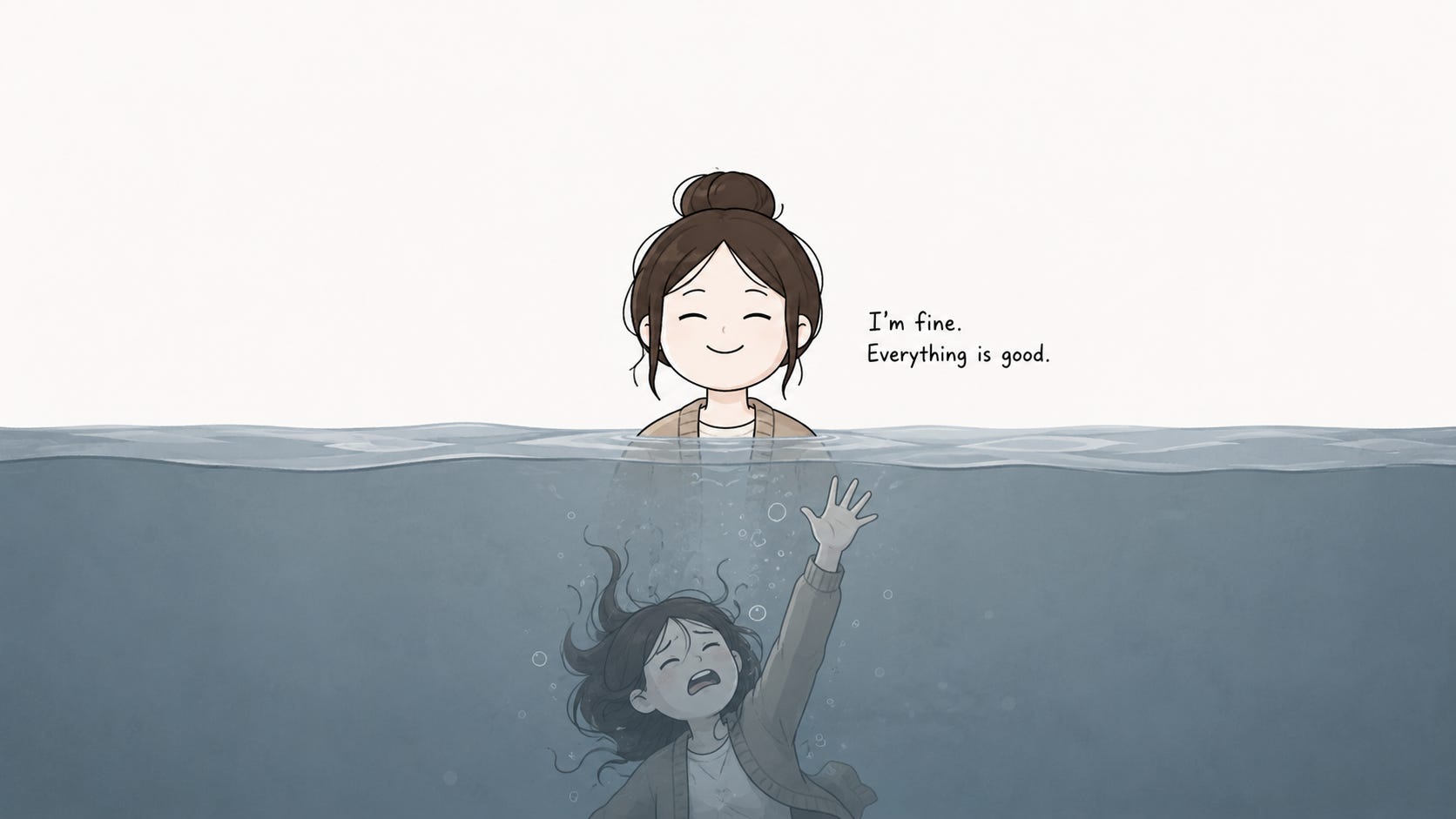
Functioning is not the opposite of pain. Sometimes it's what pain looks like when it learns to hide.

She never misses a deadline. She remembers everyone’s birthday. She’s the one people call when they’re falling apart. From the outside, she has it together.
What no one sees is that she hasn’t cried in front of another person in over six years. Not because she’s healed. Because she forgot it was allowed.
This is the quiet contradiction at the center of so many lives: competence is not the same as wellness. Sometimes, it’s the mask wellness wears.
What “High-Functioning” Actually Means
When we picture someone who’s struggling, we usually picture something visible. Missed work. Visible breakdown. Someone who can’t get out of bed.
But there’s another version of struggling that doesn’t look like struggling at all. It looks like a person who shows up early, follows through on every commitment, holds their family together, and never asks for help — because they’ve never needed it. Or so it seems.
This is what we call high-functioning. Meeting every external responsibility — work, family, the expectations of everyone around you — while carrying something heavy on the inside that nobody’s invited to see.
Here’s the idea worth sitting with: functioning is not the opposite of pain. Sometimes, functioning is what pain looks like when it’s learned to keep itself hidden.
Why It Develops
This pattern doesn’t appear out of nowhere. For a lot of people, it was built — quietly, over years, usually starting in childhood.
Picture a child who learns, early, that their needs are an inconvenience. Their sadness is met with impatience. Their fear is met with “you’re fine.” But their achievements — their good grades, their helpfulness, their ability to stay calm when everyone else is falling apart — that gets noticed. That gets rewarded.
So the child adapts. Not consciously. Just the way any young nervous system adapts to what keeps it safe. They learn: I am not loved simply for existing. I am valued for what I do.
Being “the strong one.” Being “the responsible one.” Being the one who never needs anything. These aren’t personality traits people are born with. Often, they’re strategies — brilliant, adaptive strategies — built by a child who needed to find some way to feel safe and worthy in a home that didn’t offer it freely.
And the strategy works. That’s the part that makes it so hard to see later. It gets you praise. It gets you promotions. It gets you people who depend on you. Why would you ever question something that keeps working?
The Cost
Here’s why it’s worth questioning.
A nervous system that has spent years in survival mode doesn’t know how to stop, even when the danger is gone. So it keeps running. Which is why so many high-functioning people describe a specific kind of tired — not the tired that a good night’s sleep fixes, but a tired that lives in the bones.
They can’t ask for help, even when they’re drowning, because asking for help was never safe. It might have even backfired, once, a long time ago, in a way they’ve since forgotten but their body hasn’t.
What looks like calm is often numbness. What looks like independence is often isolation. They are the person everyone else leans on. And there is, often, no one they feel they can lean on in return.
And because they function so well, this pain rarely gets named. Friends say, “but you seem fine.” Family says, “you’re the strong one, you don’t need to worry about that.” Even they start to believe it — because how could someone this capable also be this unwell?
But capability was never proof of wellness. It was proof of adaptation.
If you’re realizing, right now, that this is you — you’re not alone, and you’re not broken for functioning this well. This newsletter exists for exactly this: naming the patterns that shape us, but rarely get spoken out loud.
The Reframe
Here’s the part that matters most.
If this describes you, the goal isn’t to feel guilty for functioning. That strategy kept you safe. It may have gotten you through a childhood, a family, a set of circumstances that genuinely required it. It worked. It’s not a flaw. It’s a testament to how resourceful you had to be.
But there’s a difference between coping and healing. Coping got you through. Healing is what lets you finally put some of that weight down.
There’s a difference, too, between performing okay and actually being okay. One is a skill you built for other people. The other is something you’re allowed to build for yourself.
Noticing this pattern — really noticing it, without judgment — is often the first crack in the armor. Not a collapse. Just a crack. Enough to let something in.
You don’t have to fall apart to prove that you’re struggling. And you don’t have to keep proving you’re fine to deserve care.
If any part of this felt familiar, I’d genuinely like to know which part — hit reply or drop a comment. Sometimes just naming it out loud is where the shift starts.
It would be interesting to read some research on high functioning people, wounded, and non-high functioning people also wounded.